Ruptela Eco5 vs Rinho Zero IoT: Compact Trackers 2026
👉 Who this article is for: Integrators and fleet managers looking for compact GPS trackers for light vehicle fleets, delivery, motorcycles, or telematics projects with BLE sensors.
⚠️ Note: We are Rinho manufacturers. This analysis is based on official technical specifications from both devices. We include cases where the competitor may be the better option depending on the project.
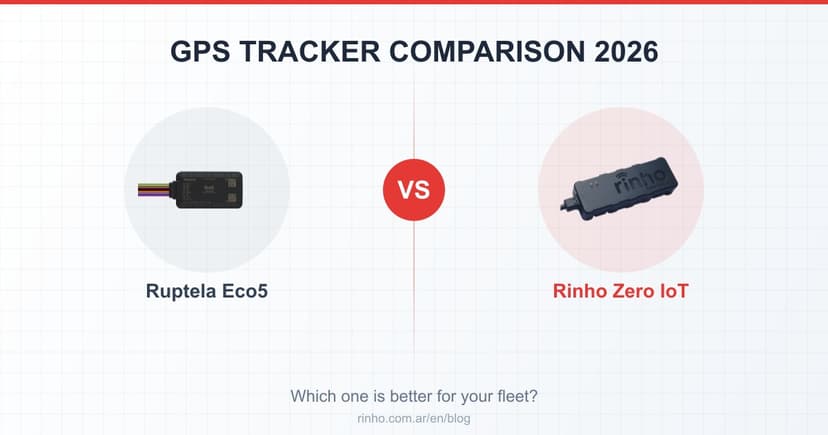
The Ruptela Eco5 is a compact tracker from the Lithuanian brand with good reputation in Europe and growing presence in LATAM. It stands out for offering two protection versions (IP54 and IP68) and multiple I/O in a reduced form factor.
Rinho Zero IoT competes in the same segment but with integrated WiFi (unique in its category), 196 programmable rules engine, and extended voltage range for electric motorcycles.
Technical Comparison Table
| Feature | Ruptela Eco5 | Rinho Zero IoT | Advantage |
|---|---|---|---|
| Cellular connectivity | LTE Cat 1/M1 + 2G | LTE Cat 1 + 2G | Tie |
| WiFi | ❌ Not available | ✅ Integrated | Zero |
| BLE for sensors | BLE 5.0 | BLE 5.0 | Tie |
| Digital inputs | 4 (+ 2 AIN/DIN) | 2 | Eco5 |
| Analog inputs | 2 (configurable) | 2 | Tie |
| Digital outputs | 2 | 1 | Eco5 |
| 1-Wire | 1 | ❌ No | Eco5 |
| Event engine | Configurable scenarios | 196 programmable rules | Zero |
| Voltage range | 9-32V DC | 9-90V DC | Zero |
| Backup battery | 180 mAh | 500 mAh | Zero |
| IP protection | IP54 or IP68 | IP65 | Eco5 (IP68) |
| Dimensions | 95×51×14 mm (IP54) | 98×32×21 mm | Eco5 lower profile |
| Sleep consumption | < 0.5 mA | < 1 mA | Eco5 |
Integrated WiFi: The Key Difference
Zero IoT is the only tracker in its segment with integrated WiFi. Eco5 doesn't offer this feature.
Use cases where WiFi makes a difference
Data download at depot: With WiFi, vehicles download accumulated data when arriving at base without consuming mobile data. Useful for fleets with high reporting volume.
Rural connectivity: Operations with Starlink at the base allow vehicles to report upon arrival even without cellular coverage during the route.
Configurable captive portal: Zero can serve a web page where drivers check-in or confirm deliveries, connected to the 196 rules engine to automate actions.
I/O: Eco5 Has More Physical Interfaces
Eco5 has an advantage in I/O quantity:
| Interface | Eco5 | Zero IoT |
|---|---|---|
| Dedicated digital inputs | 4 | 2 |
| Analog/digital inputs | 2 | 2 |
| Digital outputs | 2 | 1 |
| 1-Wire | 1 | ❌ |
If you need to connect multiple wired sensors simultaneously (fuel level, Dallas temperature, ignition, door), Eco5 offers more wiring flexibility.
However, Zero compensates with BLE 5.0 that allows connecting up to 4 wireless sensors with detailed data + BSW system to expand to more sensors.
BLE 5.0: Both Have It
This is a feature where both devices are equal. Both support:
- BLE temperature/humidity sensors
- Driver identification via ID band
- Beacons for proximity detection
Implementation difference: Ruptela uses its own accessory ecosystem. Zero IoT is compatible with Mokosmart sensors and other BLE standards.
| Compatible sensor | Use |
|---|---|
| Rinho Condition (L02S) | Temperature, humidity, door opening |
| Rinho ID Band (W6) | Driver identification, SOS button |
Event Engine: Scenarios vs 196 Rules
Ruptela Eco5 uses "Advanced Configurator" that allows configuring predefined scenarios and creating custom I/O events. It's flexible for standard cases.
Rinho Zero IoT has a 196 programmable rules engine with combined logic (AND, OR, NOT) without nesting limits.
Example: Stop alert outside geofence during work hours
In Zero IoT:
IF speed = 0
AND stopped_time > 15 minutes
AND outside_authorized_geofences = YES
AND current_time BETWEEN 08:00 AND 18:00
THEN
   Generate "Unauthorized stop" event
   Priority HIGH
One rule. Direct configuration. In Eco5, combining multiple conditions like this requires workarounds or isn't possible.
Voltage: Zero IoT for Electric Motorcycles
| Device | Voltage range |
|---|---|
| Eco5 | 9-32V DC |
| Zero IoT | 9-90V DC |
Zero IoT supports up to 90V, allowing direct installation on:
- 48V, 60V, 72V electric motorcycles
- Electric delivery scooters
- Industrial electric vehicles
With Eco5 you need an external voltage converter for these cases.
Backup Battery: 2.7x More Capacity in Zero
| Device | Battery | Approx. autonomy |
|---|---|---|
| Eco5 | 180 mAh | ~2-4 hours |
| Zero IoT | 500 mAh | ~8-12 hours |
In case of power disconnection, Zero gives significantly more time to locate the vehicle before shutdown.
IP Protection: Eco5 Offers IP68
| Device | Protection |
|---|---|
| Eco5 IP54 | Splashes |
| Eco5 IP68 | Submersible |
| Zero IoT | IP65 (water jets) |
If you need a tracker for machinery exposed to immersion (construction, agriculture under heavy rain), Eco5 IP68 version is the best option.
Zero IoT with IP65 is sufficient for motorcycles, vehicles, installations in enclosed compartments.
When to Choose Ruptela Eco5
There are scenarios where Ruptela Eco5 is the best option:
| Scenario | Why Eco5 |
|---|---|
| Need IP68 (submersible) | Only option with this protection |
| Many wired sensors | 6 inputs + 1-Wire vs 4 inputs |
| Ultra low consumption critical | < 0.5 mA in sleep |
| Already using Ruptela ecosystem | Maintain operational consistency |
When to Choose Each One?
Choose Ruptela Eco5 if:
- You need IP68 protection for submersible environments
- Your project requires 6+ simultaneous wired inputs
- Ultra-low consumption (< 0.5 mA) is critical
- You already have Ruptela infrastructure
Choose Rinho Zero IoT if:
- You need WiFi (unique in its category)
- You operate high-voltage electric vehicles (9-90V)
- You want complex automations with 196 rules
- You value 2.7x larger backup battery
- IP65 is sufficient for your application
Conclusion
Ruptela Eco5 is a compact tracker with more I/O than most in its category and IP68 option for extreme environments.
Zero IoT differentiates itself by:
- ✅ Integrated WiFi (unique in entry-level)
- ✅ 196 rules engine vs configurable scenarios
- ✅ 9-90V range for electric motorcycles
- ✅ 2.7x larger battery (500 vs 180 mAh)
The choice depends on the use case: more wired I/O and IP68 → Eco5. WiFi, advanced automation and high voltage → Zero IoT.
Need More Information?
Request a free technical evaluation — we analyze your use case and recommend the most suitable device.
📩 Contact a specialist | 📋 View Zero IoT specs
Related Articles
Related articles

Ruptela Eco5 Lite vs Rinho Zero IoT: Basic Trackers 2026
Eco5 Lite vs Zero IoT: basic GPS trackers comparison. WiFi, BLE 5.0, I/O, battery, voltage. Which offers better value for features?

Suntech ST4315 vs Rinho Zero IoT: Entry-Level Trackers 2026
ST4315 vs Zero IoT: entry-level GPS tracker comparison. WiFi, BLE, LTE Cat-M1 vs Cat-1, IP67 vs IP65. Which is better for basic fleets?

Teltonika FMC920 vs Rinho Zero IoT: Basic Trackers Comparison 2026
FMC920 vs Zero IoT: comparison of budget GPS trackers. Integrated WiFi, programmable event engine, extended voltage range. Which one is better?