Teltonika FMC150 vs Rinho Spider: Native CAN trackers comparison
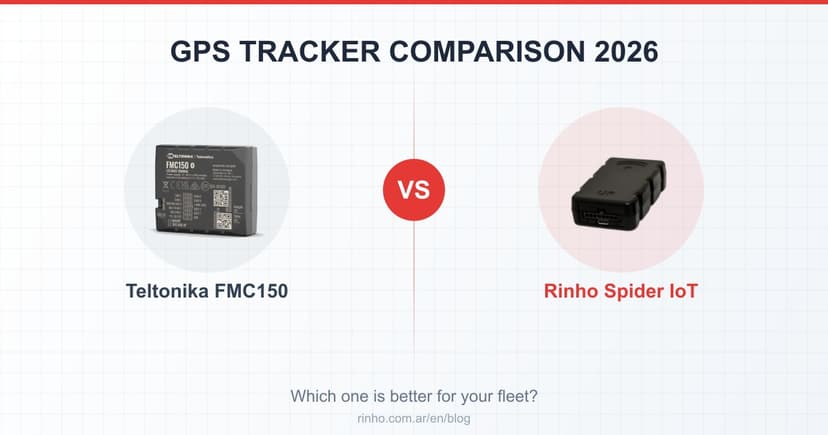
👉 Who this article is for: Integrators and fleet managers looking for a tracker with integrated native CAN and wanting to compare the two options available: Teltonika FMC150 vs Rinho Spider.
The Teltonika FMC150 is the evolution of the FMC130, incorporating an integrated CAN processor that eliminates the need for the external LV-CAN200 adapter. The Rinho Spider IoT also includes native CAN from its original design. Which one is better for your operation?
Quick comparison table
| Feature | Teltonika FMC150 | Rinho Spider IoT | Advantage |
|---|---|---|---|
| Native CAN Bus | ✅ 2 interfaces | ✅ J1939, OBDII, IESCAN | Tie |
| Event engine | 12 fixed scenarios | 196 programmable rules | Spider |
| Backup battery | 170 mAh | 500 mAh | Spider |
| Power supply | 10-30V DC | 8-38V DC | Spider |
| Integrated WiFi | ❌ No | ✅ 2.4 GHz | Spider |
| BLE | 4.0 + LE | 5.0 | Spider |
| Protection | IP41 | IP30 | FMC150 |
| Digital inputs | 3 | 4 | Spider |
| Digital outputs | 2 | 3 | Spider |
| Analog inputs | 2 | 3 | Spider |
| 1-Wire | 1 | ✅ Supported | Tie |
| LATAM tech support | Europe (+7h) | Local (same timezone) | Spider |
Both have native CAN, but they're not the same
Unlike the FMC130 that requires the LV-CAN200 adapter, the FMC150 already includes integrated CAN. This puts it in direct competition with the Spider.
CAN data available on each device
Teltonika FMC150:
- Fuel level (dashboard)
- Total fuel consumption
- Wheel speed
- Distance traveled (odometer)
- Engine RPM
- Accelerator position
Rinho Spider IoT:
- All standard J1939/FMS parameters
- Complete OBDII (gasoline/diesel)
- IESCAN (proprietary protocol)
- Speed, RPM, fuel, temperature
- DTC codes (diagnostics)
- Engine hours
The key difference: supported protocols
| Protocol | FMC150 | Spider |
|---|---|---|
| J1939 (trucks) | ✅ | ✅ |
| OBDII | Via BLE dongle | ✅ Native |
| IESCAN | ✅ | ✅ |
| FMS | ✅ | ✅ |
The Spider natively supports IESCAN, a protocol used in industrial vehicles and heavy machinery that the FMC150 doesn't handle directly.
The WiFi factor: Captive portal and data download
A fundamental difference that many overlook:
| Feature | FMC150 | Spider |
|---|---|---|
| Configurable captive portal | ❌ Not available | ✅ Integrated |
| Data download without cellular | USB/Bluetooth only | WiFi (faster) |
| Firmware update | FOTA (cellular only) | FOTA (WiFi or cellular) |
| Actions from web page | ❌ No | ✅ Connected to event engine |
Captive portal: The key differentiator
Spider can serve a configurable captive portal web page. This allows:
- Custom action buttons connected to the 196 rules engine
- Driver check-in before starting a trip
- Pre-operational inspection forms for the vehicle
- Delivery confirmation without external app
Any action on the portal can trigger events, alerts, or state changes in the tracker.
With FMC150, this simply doesn't exist — it requires an external app or separate web platform.
Event engine: 12 vs 196 rules
This is probably the biggest technical difference between both devices.
Teltonika FMC150: Predefined scenarios
The FMC150 offers 12 configurable scenarios:
- Green Driving
- Overspeed
- Jamming detection
- GNSS Fuel Counter
- DOUT control by call
- Excessive idling
- Immobilizer
- iButton
- Unplug detection
- Towing detection
- Crash detection
- Geofence (auto/manual)
Rinho Spider: 196 programmable rules
The Spider allows creating up to 196 rules with complete conditional logic:
IF speed > 80 km/h
AND engine_on = true
AND geofence = "school_zone"
THEN activate_output_1 + send_alert
You can combine:
- Any input (digital, analog, CAN)
- BLE sensor data
- Geofences
- Schedules
- Vehicle states
And execute multiple simultaneous actions.
Backup battery: autonomy on disconnection
| Specification | FMC150 | Spider |
|---|---|---|
| Capacity | 170 mAh | 500 mAh |
| Estimated autonomy | ~2-4 hours | ~8-12 hours |
| Disconnection detection | ✅ | ✅ |
With 3x more capacity, the Spider can continue reporting position for longer if someone disconnects the vehicle's power (theft attempt, tampering, etc.).
Voltage range: vehicle compatibility
| Device | Range | Applications |
|---|---|---|
| FMC150 | 10-30V DC | 12V cars, 24V trucks |
| Spider | 8-38V DC | Cars, trucks, machinery, boats |
The Spider supports:
- Lower voltages (8V): useful when vehicle battery is low
- Higher voltages (38V): industrial machinery, some electrical systems
BLE: Bluetooth 4.0 vs 5.0
| Feature | BLE 4.0 (FMC150) | BLE 5.0 (Spider) |
|---|---|---|
| Range | ~50m | ~200m |
| Speed | 1 Mbps | 2 Mbps |
| Consumption | Medium | Low |
| Simultaneous sensors | Limited | More devices |
With BLE 5.0, the Spider can:
- Read sensors at greater distance (trailer, tow)
- Connect more sensors simultaneously
- Lower battery consumption on sensors
When to choose each device
👉 Choose Teltonika FMC150 if:
- You already have Teltonika infrastructure and want to maintain compatibility
- You need IP41 (environments with some dust)
- Your operation is mainly in Europe with local support
- The 12 predefined scenarios cover all your needs
- You don't need captive portal or direct driver interaction
👉 Choose Rinho Spider if:
- You need advanced event logic (196 programmable rules)
- You want WiFi captive portal for driver interaction
- You operate in LATAM and value support in your same timezone
- You need greater backup battery autonomy
- You work with vehicles that use IESCAN
- BLE 5.0 is important for remote sensors
⚠️ When NOT to choose Rinho Spider
Being honest, the Spider is not the best option if:
- You need IP65+: For outdoor installation or off-road vehicles, consider Rinho Zero (IP65)
- Your fleet is 100% Teltonika: Migrating has training and configuration costs
- You only need basic tracking: Both devices are "overkill" for simple tracking
Final verdict
| Aspect | Winner |
|---|---|
| Native CAN | Tie |
| Event engine | Spider (196 vs 12) |
| Backup battery | Spider (3x more) |
| WiFi | Spider (only one with WiFi) |
| BLE | Spider (5.0 vs 4.0) |
| IP protection | FMC150 (IP41 vs IP30) |
| LATAM support | Spider |
The FMC150 is a good device that corrects the main weakness of the FMC130 (external CAN). But the Spider offers more flexibility, better battery, integrated WiFi, and a significantly more powerful event engine.
Want to evaluate the Spider for your operation?
Contact us to receive an evaluation unit and directly compare both devices in your fleet.
We don't sell "the best tracker in the world". We sell the right solution for your operation. If after evaluating you decide that the FMC150 is better for you, we'll tell you.
Related articles
- Teltonika FMC130 vs Rinho Spider: The truth about CAN Bus
- What is CAN Bus and how does it work?
- CAN Bus capture with CXECU: Complete guide
- Complete comparison: Event Engines in GPS Trackers 2026
- Is your tracker draining the battery? LVD solution
📖 View Spider IoT specifications | 📩 Request quote
⚠️ Disclaimer: Teltonika FMC150 specifications were obtained from official Teltonika documentation (datasheet DS-FMC150, February 2026). Specifications may change without notice. Always verify with the manufacturer before making purchasing decisions.
Related articles

Teltonika Competitors & Alternatives 2026: FMC130, FMC920, FMC650
Model-by-model guide for integrators: FMC920, FMC130, FMC150 and FMC650 vs Rinho trackers. WiFi, event engine and LATAM support compared.

Teltonika FMC650 vs Rinho Smart IoT: Professional Trackers 2026
FMC650 vs Smart IoT: professional trackers comparison. I/O, CAN Bus, tachograph, WiFi. Which is best for heavy-duty fleets in LATAM?

Teltonika FMC130 vs Rinho Spider IoT: CAN Bus and beyond
FMC130 vs Spider IoT: Native CAN or external adapter? We compare WiFi, event engine, and total cost. Technical guide for commercial fleets.