Virtual Trailer Coupling: Rinho and MOKOSmart

In the competitive world of freight transport, information is power. Knowing exactly which tractor is pulling which trailer, who is driving it, and under what conditions the cargo is traveling, is no longer a luxury: it's an operational necessity.
Introduction: The Modern Transport Challenge
For years, transport companies in Latin America have struggled with manual logging systems, expensive hardware, and fragmented solutions that don't communicate with each other. The result: documentation errors, losses due to cold chain breaks, unauthorized vehicle use, and incomplete traceability that complicates everything from billing to insurance claims.
At Rinho Telematics, we have been designing and manufacturing GPS and IoT devices for fleets for over 18 years. With more than 200,000 devices installed in Argentina, Bolivia, Paraguay, Chile, and other countries in the region, we understand the specific needs of the Latin American market. And today we want to share how, together with MOKOSmart, we are solving these challenges with an elegant solution, without cables and without complications.
The Problem: Why Is It So Hard to Track Trailers?
The Operational Reality
A tractor can hitch and unhitch multiple trailers in a single day. In distribution operations, the same trailer can pass through 3 or 4 different tractors in a week. In refrigerated transport, each trailer has its own temperature requirements that must be monitored independently of the tractor pulling it.
Traditional Methods and Their Limitations
Manual paper logging:
- Prone to human error
- Outdated information (logged at end of day, not in real-time)
- Impossible to audit reliably
- Doesn't scale when the fleet grows
Wired RFID readers:
- Require complex installation in each tractor
- Cables that get damaged with use
- Additional failure points
- High cost per unit
Independent GPS systems on each trailer:
- Duplication of costs (SIM, data, hardware)
- Two systems that don't communicate natively
- Greater management complexity
- Multiplied maintenance
Wired temperature sensors:
- Invasive installation
- Cables exposed to mechanical damage
- Difficult to move between trailers
- Require external power
What Our Clients Were Asking For
After years of listening to fleet operators, the request was clear:
We want to know which trailer each tractor has, in real-time, without having to do anything manual. And if it's refrigerated, we want the temperature. And we want to know who is driving it. And we don't want to install more cables.
It seemed like a lot to ask. But BLE (Bluetooth Low Energy) technology makes it possible.
The Solution: Natively Integrated BLE Sensors
Why BLE?
Bluetooth Low Energy is a wireless communication technology specifically designed for devices that need to transmit small amounts of data with minimal energy consumption. Its advantages for transport applications are enormous:
| Feature | Fleet Benefit |
|---|---|
| Low consumption | Batteries that last years, not weeks |
| No cables | Installation in minutes, not hours |
| Sufficient range | 10-150 meters depending on configuration |
| Standard protocol | Compatibility between manufacturers |
| Low cost | Sensors accessible for fleets of any size |
The Rinho Advantage: Factory-Embedded BLE
Here's the key difference: all Rinho trackers (Spider IoT, Smart IoT, and Zero IoT) include a BLE 5.0 module integrated at the factory. It's not an optional accessory, it's not an external module you have to buy separately. It's inside the device, ready to use.
This means that if you already have a Rinho tracker installed in your tractor, you already have the ability to read BLE sensors. You just need to add the sensors.
MOKOSmart: The Ideal Sensor Partner

After evaluating multiple BLE sensor manufacturers, we chose to work with MOKOSmart for several reasons:
- Proven quality: More than 17 years in the market, CE, FCC, RoHS certifications
- Product variety: Temperature, humidity, door, presence, identification sensors
- iBeacon/Eddystone support: Standard protocols that facilitate integration
- Customization: Ability to adjust parameters and even branding
- Price/quality ratio: Professional sensors at accessible prices
The two products we use most in this solution are:
| MOKOSmart Sensor | Rinho Product | Main Application |
|---|---|---|
| L02S Condition Sensor | Rinho Condition | Virtual coupling + Temperature + Door status |
| W6 Wristband Beacon | Rinho ID Band | Driver identification + Start control |


Technical Architecture: The BSW and BS Modules
To understand how this solution works, it's important to know the two BLE modules incorporated in Rinho trackers:
BSW Module (Wildcard): The Discoverer
The BSW module is responsible for detecting and discovering BLE devices in the environment. Its most important feature is that it works with filters, not with specific MAC addresses.
What does this mean?
Instead of telling the tracker "look for the sensor with MAC AA:BB:CC:DD:EE:FF", we tell it "look for any sensor transmitting with UUID X, Major Y, Minor Z". This allows:
- Detecting any trailer in the fleet without pre-configuring each tractor-trailer combination
- Detecting any authorized driver without listing each MAC address
- Scaling the solution without manual intervention every time a new asset is added
Filters available in BSW:
| Filter | Description |
|---|---|
| UUID | Unique 128-bit identifier |
| Major | 16-bit number (e.g., asset type) |
| Minor | 16-bit number (e.g., individual ID) |
| RSSI | Signal strength (distance filter) |
Configuration example:
| Parameter | Value |
|---|---|
| UUID | FDA50693-A4E2-4FB1-AFCF-C6EB07647825 |
| Major | 100 (refrigerated trailers) |
| Minor | * (any) |
| RSSI | -70 dBm (maximum ~5 meters) |
Types of sensors BSW can detect:
- Escort TT, TH, TD, DU
- MOKO T&H, Door, Condition
- Any standard iBeacon device
BS Module (Fixed Sensor): The Data Reader
Once BSW detects a device, the BS module comes into play. This module listens to the data transmitted by a specific sensor (identified by its MAC address) continuously.
Important: BLE sensors like the L02S constantly transmit their data in broadcast mode. The BS module doesn't "request" information from the sensor, but rather passively listens to transmissions and captures data when the sensor is on its configured list. This is more energy efficient and doesn't require establishing a bidirectional connection.
Data that BS can capture:
L02S Sensor (Rinho Condition):
| Data | Range/Precision |
|---|---|
| Temperature | -40°C to +85°C (±0.5°C) |
| Humidity | 0-100% RH (±2%) |
| Door status | Open/Closed (Hall sensor) |
| Movement | 3-axis accelerometer |
| Barometric pressure | hPa |
| Battery level | % |
W6 Sensor (Rinho ID Band):
| Data | Description |
|---|---|
| Presence | Detected/Not detected |
| Movement | 3-axis accelerometer |
| SOS Button | Pressed/Not pressed |
| Battery level | % |
The Complete Flow: BSW Detects, BS Captures
The magic happens when both modules work together:
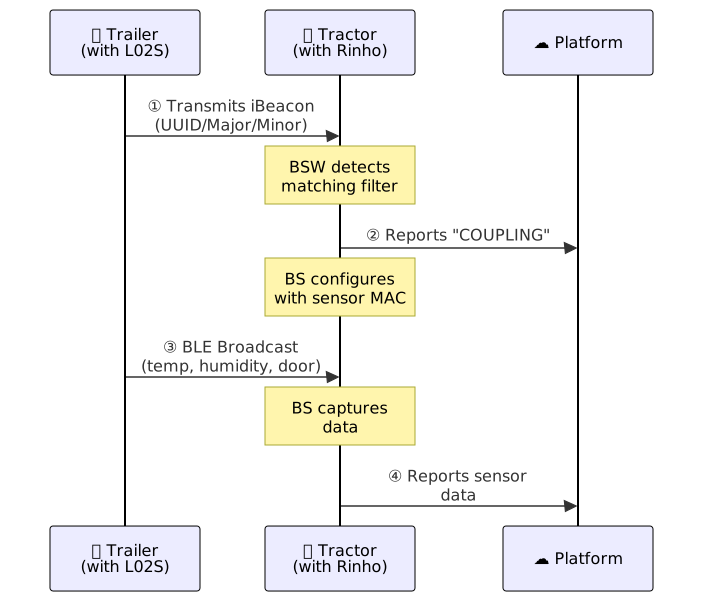
Use Case 1: Virtual Trailer Coupling
The Scenario
A refrigerated transport company operates 50 tractors and 120 trailers. Trailers rotate constantly between tractors according to the day's routes. Some transport meat (require -18°C), others dairy (2-8°C), others fruits (10-12°C).
The Implementation
Step 1: Install L02S sensor on each trailer
The Rinho Condition sensor (MOKOSmart L02S) is installed inside the trailer, near the door. Typical installation: 10 minutes with 3M double-sided tape or screws.
Each sensor is configured with:
- Common UUID for the entire fleet
- Major according to cargo type (100 = refrigerated meat, 101 = refrigerated dairy, etc.)
- Unique Minor for each trailer (001, 002, 003...)
Step 2: Configure the Rinho tracker in each tractor
The tracker already installed in the tractor is configured via remote command to:
- Activate BSW module with fleet UUID filter
- Filter by RSSI to detect only "hitched" (nearby) trailers
- Configure scan interval (typical: every 30 seconds)
Step 3: Automatic operation
When a tractor approaches a trailer:
- BSW detects the L02S beacon
- The system logs the "virtual coupling" with timestamp
- BS is automatically configured to read L02S data
- Temperature monitoring begins
When the tractor moves away:
- BSW stops detecting the beacon
- The system logs the "virtual uncoupling"
- BS releases the connection
The Results
| Metric | Before | After |
|---|---|---|
| Coupling logging time | 5-10 min (manual) | 0 min (automatic) |
| Logging errors | ~15% | 0% |
| Temperature visibility | On arrival at destination | Real-time |
| Cold chain alerts | None | Immediate |
| Installation cost per trailer | $200-500 (wired) | $50-80 (BLE sensor) |
Use Case 2: Driver Identification and Start Control
The Scenario
A logistics company needs to:
- Know who is driving each vehicle at all times
- Prevent unauthorized people from starting vehicles
- Automatically log the start and end of each shift
- Have a panic button for emergencies
The Implementation
Step 1: Give each driver a W6 wristband
Each driver receives a personalized Rinho ID Band wristband (MOKOSmart W6). The wristband is configured to transmit:
- Company UUID
- Major according to category (101 = authorized truck driver, 102 = authorized utility vehicle driver)
- Unique Minor for each driver
Step 2: Configure the trackers
Option A - By filter (recommended for large fleets):
- BSW filters by UUID + Major
- Any authorized driver can use any vehicle in their category
Option B - By MAC (for specific vehicles):
- Specific authorized driver MACs are configured for that vehicle
- Greater control, but requires individual configuration
Step 3: Configure start control (optional)
The Rinho tracker can control a relay that enables/disables starting:
- No wristband detected → start blocked
- Authorized wristband detected → start enabled
- Unauthorized wristband → start blocked + alert to central
Operation Flow

Additional W6 Features
The W6 wristband is not just an identifier. It includes:
SOS Button: When pressing the button, the tracker detects the event and sends an immediate alert to the central with:
- Driver identification
- Vehicle GPS location
- Event timestamp
Fall detection: The 3-axis accelerometer can detect movement patterns compatible with a fall. Useful for drivers who perform loading/unloading tasks.
Integrated RFID: The same wristband can be used for facility access control, check-in/check-out, or access to restricted areas.
Use Case 3: Cold Chain Monitoring
The Scenario
A pharmaceutical distributor must ensure that medications are transported between 2°C and 8°C. Any deviation must be documented to comply with health regulations.
Implementation with L02S
The L02S sensor is ideal for this application because:
- Precision: ±0.5°C temperature reading accuracy
- Local storage: Stores up to 60,000 records internally (useful if there's connection loss)
- Hall sensor: Detects door opening (critical moment for temperature variation)
- IP67: Resistant to washing and humid environments
- 5-year battery: Minimal maintenance
Alert Configuration
The system can be configured to alert when:
| Condition | Action |
|---|---|
| Temperature > 8°C | Yellow alert to driver |
| Temperature > 10°C for more than 5 min | Red alert to central |
| Temperature < 2°C | Freezing alert |
| Door open > 3 min | Door alert |
| No sensor data > 10 min | Failure alert |
Detailed Technical Specifications
Rinho Condition (MOKOSmart L02S)
| Specification | Value |
|---|---|
| Connectivity | Bluetooth Low Energy 5.1 |
| Protocols | iBeacon, Eddystone |
| Range | Up to 150m (unobstructed) |
| Operating temperature | -40°C to +85°C |
| Temperature precision | ±0.5°C |
| Humidity precision | ±2% RH |
| Integrated sensors | Temperature, Humidity, Hall (door), 3-axis Accelerometer, Barometric pressure |
| Storage | 60,000 records |
| Battery | 1000mAh replaceable |
| Battery life | ~5 years (typical config.) |
| Protection | IP67 |
| Dimensions | 69.9 x 46.7 x 18mm |
| Certifications | CE, FCC, RoHS |
Rinho ID Band (MOKOSmart W6)
| Specification | Value |
|---|---|
| Connectivity | Bluetooth 5.0 |
| Protocols | iBeacon, Eddystone |
| Range | Up to 150m (unobstructed) |
| Integrated sensors | 3-axis Accelerometer (falls, movement) |
| Functions | SOS Button, optional RFID |
| Battery | CR2032 replaceable |
| Battery life | ~1.5 years (typical config.) |
| Protection | IP67 |
| Format | Adjustable wristband |
| Certifications | CE, FCC, RoHS |
Compatible Rinho Trackers
| Model | BLE | WiFi | CAN Bus | Inputs | Ideal for |
|---|---|---|---|---|---|
| Spider IoT | 5.0 ✓ | ✓ | ✓ | 4 | Premium fleets, trucks with CAN |
| Smart IoT | 5.0 ✓ | ✓ | ✓ | 6 | Medium fleets, versatility |
| Zero IoT | 5.0 ✓ | - | - | 2 | Basic fleets, optimized cost |
Consolidated Benefits
For the Fleet Operator
- ✅ Total automation: Coupling, uncoupling, driver identification, all automatic
- ✅ Real-time visibility: Know what each tractor has, who is driving it, under what conditions
- ✅ Error reduction: Eliminating manual logs = eliminating human errors
- ✅ Regulatory compliance: Auditable and complete cold chain reports
- ✅ Improved security: Vehicle access control, panic button, alerts
For the Installation Team
- ✅ No cables: Sensor installation in minutes, not hours
- ✅ No complex configuration: Filters allow scaling without touching each device
- ✅ Minimal maintenance: Years of battery life, not weeks
- ✅ Integrated hardware: No need to buy or install external BLE readers
For the Finance Area
- ✅ Lower cost per asset: BLE sensors vs. wired solutions
- ✅ Fast ROI: Savings in administrative time from day 1
- ✅ Scalability: Add sensors without additional infrastructure
- ✅ Loss reduction: Early alerts = less damaged cargo
Why This Partnership Works
Rinho Telematics: Local Experience, Own Hardware
- +18 years designing and manufacturing GPS/IoT hardware in Argentina
- +200,000 devices installed in Latin America
- Own engineering: PCB design, firmware, integration
- Local support: Technical team that understands regional reality
- Manufacturing: We produce the trackers, we don't just resell them
MOKOSmart: Quality and Global Scale
- +17 years as an IoT device manufacturer
- Certifications: ISO9001, ISO14001, CE, FCC, RoHS
- Production capacity: Millions of units annually
- R&D: +70 engineers dedicated to product development
- Flexibility: OEM, ODM, customization
The Synergy

Frequently Asked Questions
Do I need to change my current Rinho trackers?
Not necessarily. If you have Spider IoT, Smart IoT, or Zero IoT trackers, they already have the integrated BLE module. You just need to update the configuration (done remotely) and add the sensors.
How many sensors can a tracker read?
Each Rinho tracker can connect up to 8 BLE sensors simultaneously through the BS module. The BSW module can detect many more, but detailed data capture is limited to 8 stable connections.
What happens if the truck loses cellular signal?
The tracker stores events and sensor data in its internal memory (black box). When it recovers connectivity, it sends the entire history. Additionally, the L02S sensor has its own storage of 60,000 records.
Do the sensors work in cold storage?
Yes. The L02S is designed to operate from -40°C. BLE transmission works correctly in extreme cold environments.
Can I use sensors from other manufacturers?
The BSW module is compatible with Escort sensors and any device that transmits in standard iBeacon or Eddystone format. However, we recommend MOKOSmart sensors for their proven quality and support.
What is the installation process?
- L02S sensor on trailer: Stick with 3M tape or screw in. 10 minutes.
- W6 wristband for driver: Deliver and register in system. 2 minutes.
- Tracker configuration: Remote command from the platform. No physical intervention.
Conclusion: The Future is Wireless
The combination of trackers with embedded BLE and professional quality sensors is transforming what is possible in fleet management. What previously required complex installations, cables, and multiple systems, is now solved with devices that communicate wirelessly, automatically, and intelligently.
At Rinho Telematics we are proud of this collaboration with MOKOSmart. Together, we are bringing cutting-edge technology to fleets of all sizes in Latin America, with solutions that really work in the real world of transport.
And this is just the beginning. We are already working on new applications:
- Tire pressure monitoring
- Fuel level sensors
- Environmental control in silo bags
- Tool and equipment tracking
- And much more...
Want to Implement This Solution?
Contact us for a free evaluation of your fleet. Our technical team can help you design the ideal solution for your operation.
Rinho Telematics
- 🌐 Web: www.rinho.com.ar
- 📧 Email: contacto@rinho.com.ar
- 📍 Buenos Aires, Argentina
Mentioned products:
© 2026 Rinho Telematics. +18 years designing IoT for fleets. Argentine engineering, +200,000 devices in Latin America.
Related articles

Temperature Sensor: Installation Tutorial
Complete tutorial for installing and configuring temperature sensors with Rinho devices: cold chain monitoring made simple.
Trailer Temperature Monitoring with Swappable Reefers
How to monitor temperature in reefer trailers that rotate between tractors: numbered 1-Wire sensors that the GPS tracker recognizes on its own at hitch-up.

iButton vs RFID vs BLE: Choosing a Driver ID System
iButton vs RFID vs BLE: compare the three driver identification technologies (gesture, durability, cost, key sharing) and choose the right one for your fleet.